
Last updated November 4, 2026
 Wood & steel frame
 Wrought iron
 Farm & ranch
 Sliding driveway gates
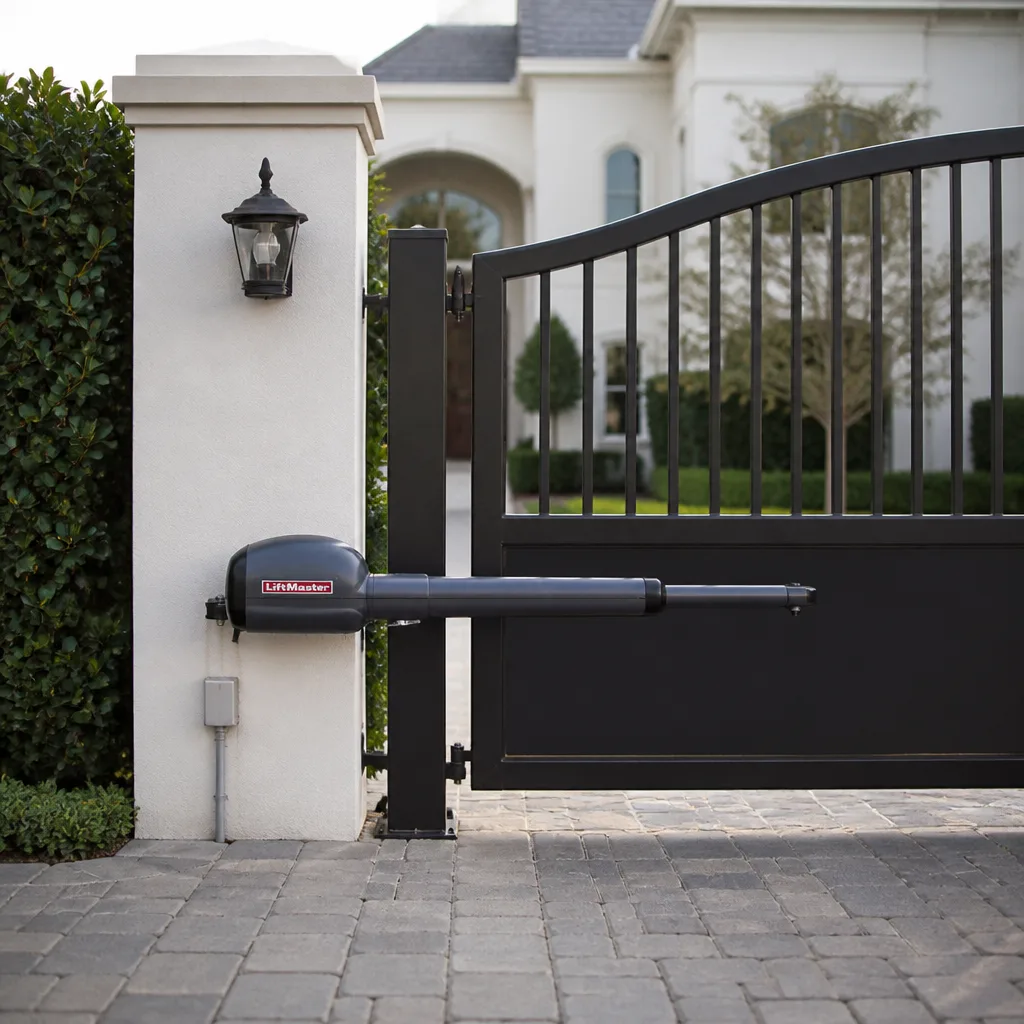 LiftMaster operators
Free on-site gate assessment - hinges, posts, and your LiftMaster or Nice gate operator checked before anything is quoted
The assessment is free and the quote is the invoice.
Get your free estimateGate Repair Emergency Preparedness Guide for Lakewood Homes
During the last major Lakewood-area power outage, the most common call gate technicians received wasn’t “my gate won’t open.” It was “I didn’t know my gate had a manual release.” The emergency already happened. The preparation hadn’t. Most homeowners in Lakewood never think about their automatic gate until it stops working, and by then they’re standing in the driveway with a car trapped on one side and no idea what to do next. This guide is about eliminating the variables you can control before the crisis. You’ll learn where your manual release is, how to test your battery backup, what to do after a forced-entry attempt, and how to build an emergency information sheet that turns a midnight gate failure from a panic into a procedure.
Quick Answer
Every electric gate has a manual release mechanism that disengages the operator so you can move the gate by hand. Knowing where that release is, testing it before you need it, and keeping your operator’s model number and your technician’s phone number in one place is the difference between a ten-minute fix and a stranded car. This guide covers manual releases for the five most common residential operators in Lakewood, battery backup testing, temporary security after a break-in attempt, and how to safely move a commercial slide gate without damaging it or hurting yourself.
Styles & brands we work with
- Wrought iron
- Wood & steel frame
- Farm & ranch
- Sliding driveway gates
- LiftMaster operators
Table of Contents
- How to Locate and Use the Manual Release on Common Lakewood Gate Operators
- What to Do When the Manual Release Mechanism Is Seized
- Gate Stuck Open After a Forced-Entry Attempt: Temporary Security Steps
- Battery Backup Systems: What They Actually Cover and How to Test Them
- Building an Emergency Gate Information Sheet
- Safely Moving a Heavy Commercial Slide Gate Without Damaging the Drive System
- What Actually Happens to Your Gate During a Lakewood Power Outage
- Common Mistakes to Avoid
- When to Call a Professional
- Frequently Asked Questions
- The Bottom Line
How to Locate and Use the Manual Release on Common Lakewood Gate Operators
Your gate’s manual release is the single most important emergency feature you’ve probably never used. It disconnects the gate from the operator’s drive mechanism so you can push or pull the gate by hand. On most residential operators in Lakewood, the release is either a pull handle, a key-operated cylinder, or a lever located on the operator itself or on the gate’s drive rail.
Here’s where to look on the five most common residential operators we see across the area:
- LiftMaster: Look for a red release handle or cord on the operator arm. Pull it firmly downward to disengage. On some models, the release is a keyed bypass on the side of the operator housing. You’ll hear a distinct click when the gate disengages from the drive.
- FAAC: FAAC operators typically have a manual release key located on the operator body. Insert the key, turn it a quarter turn, and the gate will free up. On FAAC swing arms, look for a release pin near the point where the arm meets the gate bracket.
- BFT: BFT units use a release lever on the side of the operator. Push or pull the lever depending on the model, and the gate will decouple. Some BFT slide operators have the release inside a small access panel secured with a hex screw.
- Linear: Linear swing operators have a visible release handle near the mounting point. Linear slide operators often use a clutch release that you turn counterclockwise to disengage. You may need to hold the release open while you move the gate manually.
- Ghost Controls: Ghost Controls systems pair with an app, but the physical release is a lever on the operator arm itself. It’s bright red on most models and pulls straight out from the arm.
If you’ve never located yours, do it this week. Open the operator cover if needed, find the release, and try it once. A gate that hasn’t been manually released in years can be surprising. Sometimes the release works, sometimes it doesn’t. That brings us to the next section.
When the release works, the gate will move freely. Swing gates push open like a regular door, though they’re heavier than they look. Slide gates roll along the track, but the drive gear no longer holds them in place. You can move them by hand, slowly.
What to Do When the Manual Release Mechanism Is Seized
A manual release that hasn’t been touched in years often seizes. The release handle won’t pull, the key won’t turn, or the lever is frozen in place. When this happens during an emergency, forcing it usually makes things worse. Bent release rods and broken key cylinders are common results of panicked yanking on a stuck mechanism.
Here’s what to do instead:
- Stop applying force. A seized release is a mechanical problem, not a strength problem. If it doesn’t move with firm, steady pressure, it’s not going to move with violence.
- Check for an obstruction. Dirt, dust, and spiderwebs accumulate inside operator housings in Lakewood’s dry climate. Look for debris blocking the release path. Sometimes a shot of dry lubricant into the mechanism frees it, but don’t use grease, which attracts more grit.
- Look for a secondary release point. Some operators have a release at both the operator and the gate bracket. If one is seized, the other may still work.
- If the gate is stuck closed and you need your car out now: The release mechanism is the only safe way to disengage the drive. If it won’t budge, you have two options: call for gate repair immediately, or, on swing gates, check whether the gate can be unbolted from the operator arm. Do not cut or force the arm off while the operator is still trying to drive the gate. That converts a stuck gate into a broken operator and a dangerous situation.
We recommend testing your manual release twice a year. Once at the start of spring, once at the start of fall. It takes five minutes and it tells you whether your emergency backup actually works. If it’s seized, you want to know that on a quiet Sunday afternoon, not during a power outage with a car trapped in the driveway.
Gate Stuck Open After a Forced-Entry Attempt: Temporary Security Steps
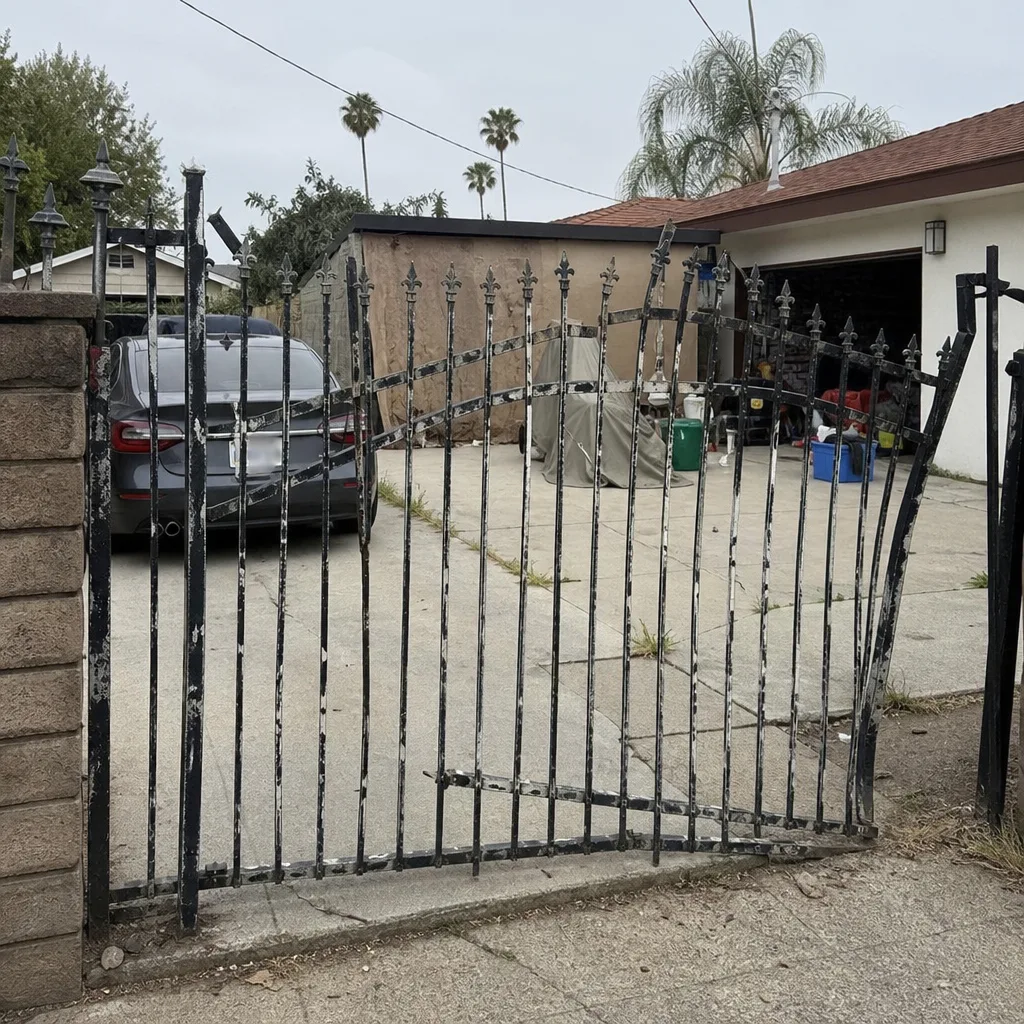
A gate that’s been forced open is a very different problem from a gate that stopped working on its own. The operator may still be trying to close it, the gate may be off its track, or the entire assembly may be bent. Your immediate job is to secure the property until a technician arrives.
Here’s the temporary security sequence we recommend for Lakewood homeowners:
- Cut power to the operator. Find the breaker or the power disconnect switch and turn it off. A damaged operator that keeps trying to cycle can injure someone or burn out its own drive motor. This is a safety step first, a repair-cost step second.
- Shore up the gate physically. If the gate is a swing gate and it’s hanging partially open, use a heavy vehicle, a length of chain and a padlock, or a temporary brace to hold it closed. Chain-link and wrought-iron swing gates can be chained to the nearest post. Slide gates can be blocked with a vehicle or a heavy object in the track.
- Photograph everything before you adjust anything. If there’s going to be an insurance claim, document the damage first. Pictures of the bent track, the damaged panel, and the operator position at the time of the incident matter.
- Call your insurance company only after the scene is documented. They’ll want their own photos, but yours taken immediately are often the most useful.
- Call a gate specialist. A forced-entry gate isn’t a handyman job. The operator, the track, the hinges, and the safety sensors all need to be evaluated. Damaged safety edges on slide gates are a particular concern: a gate that doesn’t know when to stop reversing is dangerous to children and pets.
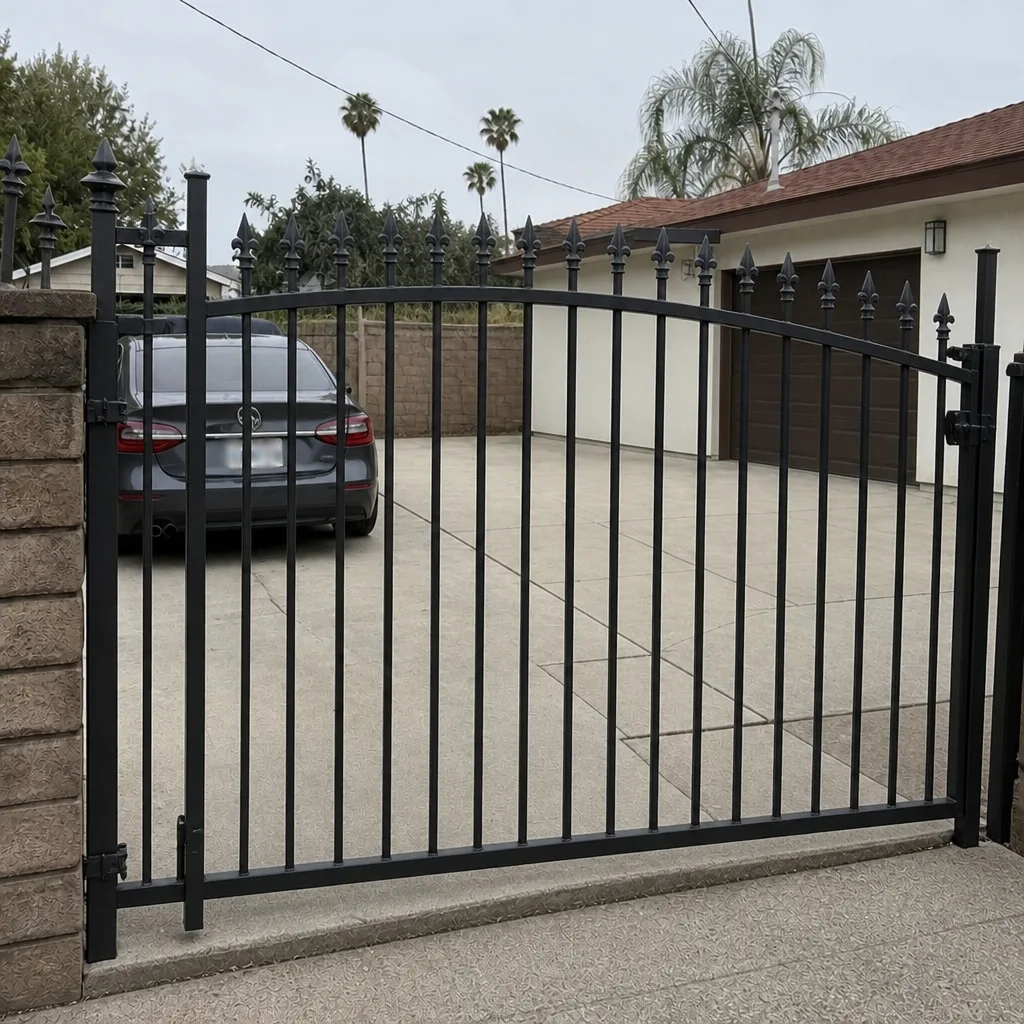
The good news is that most forced-entry gate damage in Lakewood is repairable. The bad news is that running the gate before it’s evaluated often turns a bent bracket into a shredded gearbox.
Battery Backup Systems: What They Actually Cover and How to Test Them
Here’s something most Lakewood homeowners don’t realize about battery backup systems on electric gates: they’re not designed to run your gate normally for days. They’re designed to let the gate cycle a limited number of times during a power outage so you can get your car in and out. Then they need to recharge.
Under typical use, a residential battery backup on a single-family swing gate supports 10 to 30 cycles before it’s depleted, depending on the gate’s weight, the operator model, and how well the battery has been maintained. A slide gate with a heavier panel will drain a battery faster. A double swing gate drains it faster still. Commercially rated backups last longer, but they’re also sized differently.
What battery backup does not cover:
- It does not power your access keypad or intercom system indefinitely. Some systems tie those to house power separately.
- It does not make an old, failing battery work like new. Batteries degrade over time, especially in heat. Lakewood summers are hard on lead-acid batteries in operator housings.
- It does not replace the manual release. If the battery dies and the power is still out, the manual release is still your only way in or out.
Testing your battery backup before you need it takes about ten minutes. Here’s the process:
- Turn off the breaker that powers the gate operator. The gate should remain functional on battery power.
- Cycle the gate open and closed using your normal remote or keypad. Count the cycles.
- If the gate slows noticeably after four or five cycles, the battery is weak and should be replaced.
- Leave the breaker off for half an hour, then test again. A battery that can’t hold a small charge overnight won’t help you during a long outage.
- Turn the breaker back on. The battery will recharge automatically.
If your gate doesn’t have a battery backup at all, and you want one, this is a conversation to have with a specialist. Not every operator supports a retrofit cleanly, and a poorly installed backup system can void the operator’s warranty. The right time to install battery backup is not during an outage. It’s now.
Building an Emergency Gate Information Sheet
The single most useful thing you can do for your future self is write down the details of your gate system before something goes wrong. We’re not talking about a binder. We’re talking about one sheet of paper, hung inside the garage or stored in your phone.
Here’s what goes on it:
- Operator make and model: LiftMaster, FAAC, BFT, Linear, Ghost Controls, or whatever you have. The model number is on a label on the operator housing. Write it down now, while the sun is out and you’re not in a hurry.
- Gate serial number: Also on the label. Useful if a part needs to be ordered.
- Manual release location and procedure: In your own words. “Red handle on the side of the operator, pull down.” Test the wording on a family member who has never touched the gate.
- Access code reset procedure: If you’ve changed your keypad code recently, write down how to do it. If you don’t know how to reset the code, find out now. Post-break-in, changing the access code is the first security step.
- Your preferred gate technician’s phone number: If you don’t have one yet, call Waverly Gate Repair and put us on the sheet. In our experience, homeowners who have a gate specialist’s number saved before the emergency wait less time and spend less money than those who start searching frantically at 6 a.m. with a gate dangling in the driveway.
- Breaker location: Which breaker controls the gate operator. Label it at the panel.
- Whether you have battery backup, and when you last tested it.
That’s the whole sheet. It takes fifteen minutes to create and it removes about eighty percent of the panic from a gate emergency. The remaining twenty percent is a call to a technician who knows what they’re looking at.
Safely Moving a Heavy Commercial Slide Gate Without Damaging the Drive System
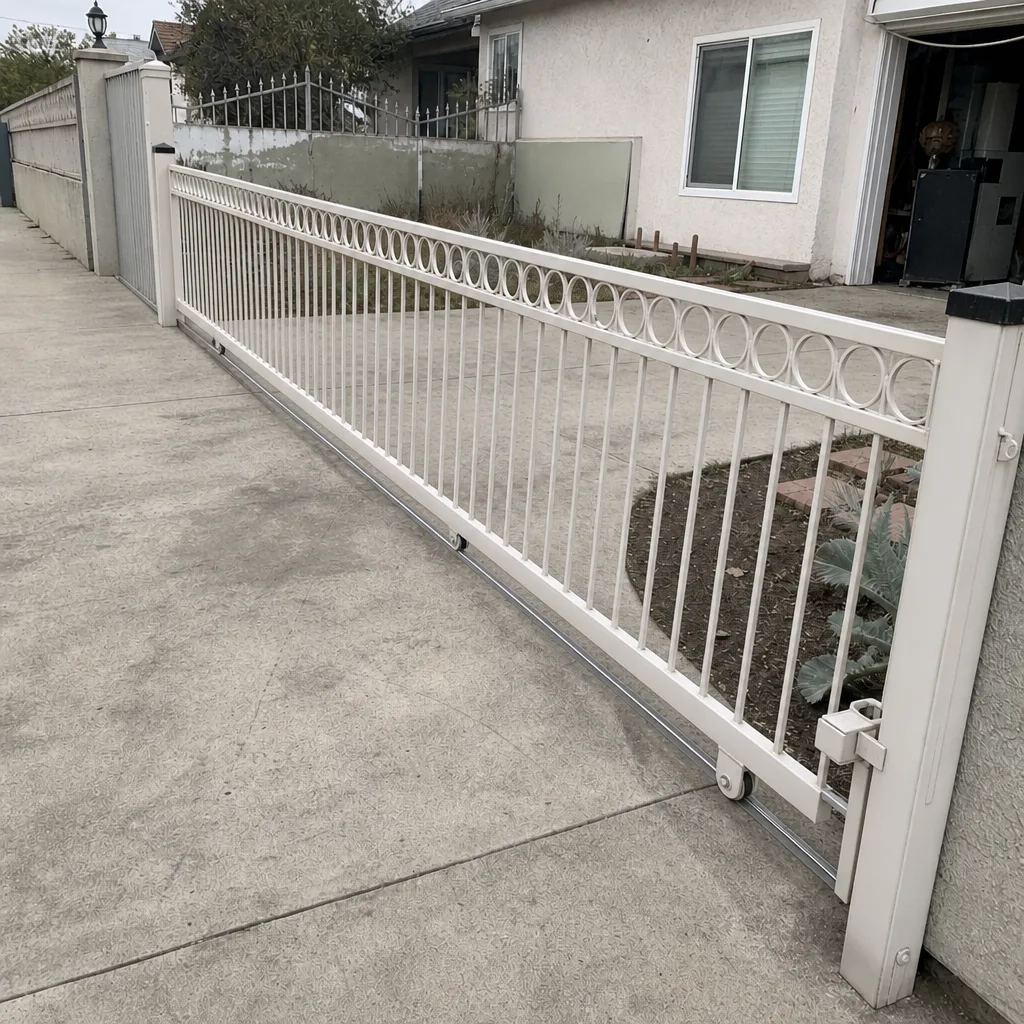
Commercial slide gates are a different animal from residential swing gates. They’re heavier, they roll on bigger wheels, and they’re driven by a chain or gear rack that’s bolted along the full length of the gate. If you try to move one by hand without disengaging the drive first, you’re fighting the motor, the gearbox, and the gate all at once. That’s how a broken chain becomes a popped gearbox.
Here’s the safe sequence for manually moving a commercial slide gate:
- Confirm the operator is disengaged. Commercial operators have a manual release that decouples the drive gear from the rack. It’s usually a lever or a socket-wrench fitting on the operator pedestal. If the drive gear stays engaged, do not try to muscle the gate.
- Check the track for obstructions. Gravel, debris, and bent track sections are the most common reasons commercial gates bind. Clear the track completely before moving the gate.
- Use two people for any gate over 12 feet. One person pushes, one person watches the wheels and the cantilever rollers. A gate coming off its track mid-push is a crushing hazard.
- Push from the gate frame, never from the pickets or the panel face. The frame is structural. The panel sections between the frame points will flex, and if you push there, you’ll dent or twist the gate.
- Move the gate slowly, a foot at a time. Stop if you hear grinding, feel resistance that isn’t just weight, or see a wheel lift off the track.
If the gate resists, stop. Call a technician. A commercial slide gate that’s off its track or bound in the drive system is a two-person repair with the right tools, not a push-it-harder problem. In our experience, well-intentioned property managers trying to save a gate turn repairable track issues into full gate replacements more often than they’d like.
What Actually Happens to Your Gate During a Lakewood Power Outage
Lakewood’s power grid is generally reliable, but outages happen. When they do, here’s what you should expect from your electric gate.
Without battery backup, the gate simply stops where it is. If it was closed, it stays closed. If it was open, it stays open. The operator’s control board loses power, and the gate will not respond to remotes, keypads, or the garage-style wall button. The manual release is your only way to move it.
With battery backup, the gate keeps working, but with limits. You’ll get a set number of cycles before the battery depletes, as we covered above. When the battery dies, you’re back to the manual release.
Here’s one thing that surprises homeowners: when power comes back on, the gate does not automatically return to normal if it was in manual release mode. You have to re-engage the release mechanism. The gate will not know it’s been disengaged. So after the power returns, walk out, check that the release is re-engaged, and run a test cycle. If the gate opens and closes normally, you’re done. If it doesn’t, the electronics may have taken a surge during the outage, and you may be looking at a control board replacement.
For most Lakewood homeowners, a power outage is an inconvenience, not a disaster, but only if the manual release works and you know how to use it. The whole point of this guide is to make sure both of those things are true before the lights go out.
See the difference
 Before
 After
 Before
 After
 Before
 After
Stop Waiting Until the Gate Breaks
The pattern we see over and over is this: a gate makes a small noise for six months, nobody calls about it, and then one night it refuses to open. By the time we get there, a $200 board problem has become a $2,000 operator replacement. Gates rarely fail without warning. They usually fail without being listened to.
Here’s what to watch for on your electric gate repair radar:
- Slowing movement: A gate that used to open in 8 seconds and now takes 15 is telling you something. Motors wear, capacitors weaken, and wheels lose their bearings.
- New noises: Grinding, squealing, or a rhythmic thump that wasn’t there before. All of those are specific mechanical problems with names, not mysteries.
- Erratic behavior: The gate stops halfway, reverses for no reason, or ignores the remote the first time but works the second time. Control board and sensor issues often show up intermittently before they fail completely.
- Visible sag: A swing gate that droops toward the latch side is wearing out its hinges. A slide gate tilting forward is wearing its wheels or its guide posts.
The preparation mindset applies to maintenance too. A gate that gets a 20-minute inspection twice a year is less likely to become a gate emergency. And if it does, you’ll already know your manual release works, your battery backup holds a charge, and your technician’s number is on the sheet.
Common Mistakes to Avoid
- Never testing the manual release until you need it. A release that was installed ten years ago and never used may be seized, rusted, or blocked by a nest. Test it twice a year.
- Forcing a seized release. The most expensive gate repairs we do in Lakewood often start with someone pulling a release handle hard enough to snap the internal rod. Firm pressure, yes. Violence, no.
- Running a damaged gate after a forced-entry attempt. Every cycle you run on a gate with a bent track or a damaged wheel compounds the damage. Cut power and leave it off until a technician looks at it.
- Assuming the battery backup is working because the light is on. Battery backup testing means disconnecting house power and cycling the gate on battery alone. Nothing else actually tests the battery.
- Not writing down the operator model number. When the gate fails, the label is often buried, faded, or on the inside of a housing you can’t open. Write it down while you can read it.
- Trying to move a commercial slide gate alone. These gates are hundreds of pounds even before the drive binding adds resistance. Two people, minimum, and only after the drive is disengaged.
- Skipping the post-outage re-engagement step. After a power outage and a manual release, the gate is not back to normal until you re-engage the release and run a test cycle. A gate that sits in manual mode looks closed and secure, but it won’t actually lock or respond.
When to Call a Professional
Some gate problems are five-minute homeowner jobs. A dead keypad battery or a breaker that’s tripped is something you can handle with the information sheet we described above. But there’s a clear line where professional help is the right call.
Call a specialist when the manual release is seized and won’t free up with a shot of dry lubricant. Call when the gate has been forced open and the track, hinges, or operator show visible damage. Call when the battery backup test fails, meaning the gate won’t cycle or slows dramatically on battery power. Call when the control board is behaving intermittently, because intermittent electronic problems are almost never intermittent forever. And call when a commercial slide gate resists manual movement or shows signs of coming off its track.
Waverly Gate Repair offers free estimates in Lakewood. Call (866) 925-0168. We answer 24/7. Fast dispatch from 7am to 7pm, Sunday through Friday. We work on what you already have, whether that’s a LiftMaster operator, a FAAC arm, a BFT board, or a Linear drive. Your gate, our only focus.
Frequently Asked Questions
Use the manual release mechanism on the operator to disengage the drive, then push or pull the gate by hand. The release is typically a handle, lever, or keyed cylinder on the operator housing or gate arm. If you’ve never located yours, do it now, because a release that is seized during an outage leaves you with a gate you cannot move. Call (866) 925-0168 if you need the release inspected or freed up before the next outage.
Yes, every residential and commercial gate operator includes a manual release of some kind. The design varies by brand. LiftMaster uses a red handle or cord. FAAC uses a release key. BFT uses a lever. Linear uses a handle or clutch. Ghost Controls uses a red lever on the arm. If you cannot find yours, the operator’s model number will let a gate repair specialist point you to it in seconds. Call (866) 925-0168 for help identifying your configuration.
Most residential battery backups support 10 to 30 gate cycles before depleting, depending on gate weight, operator model, and battery condition. That’s usually enough for a day or two of normal coming and going, not unlimited use. Test yours by turning off the breaker and cycling the gate. If it slows after four or five cycles, the battery is weak. Call (866) 925-0168 for an exact assessment of your backup system.
Cut power to the operator immediately, then secure the gate physically with a chain, brace, or vehicle. Photograph the damage before moving anything. Do not run the gate again until a technician has inspected the track, hinges, operator, and safety sensors. Forced-entry gates are repairable in most cases, but running them while damaged turns minor problems into major ones. Call (866) 925-0168. We answer 24/7. Fast dispatch from 7am to 7pm, Sunday through Friday.
Only after the drive is fully disengaged and only with two people. Commercial slide gates weigh hundreds of pounds, and moving one against the drive system can strip the gear rack or pop the gearbox. Clear the track first, push from the frame not the panel face, and stop immediately if you feel resistance. If it won’t move smoothly, call (866) 925-0168 for a professional evaluation.
Keep one sheet with the operator make and model, the gate serial number, the manual release location and procedure, the access code reset steps, the breaker location, and your technician’s phone number. Hang it in the garage or keep it in your phone. Fifteen minutes of documentation now saves hours of panic later. Call (866) 925-0168 to get Waverly Gate Repair on that sheet.
The Bottom Line
The gate emergencies that go smoothly in Lakewood are the ones where the homeowner already knew the manual release, the battery backup status, and the technician’s number. The ones that go badly are the ones where the first time anyone looked at the release was after the power went out. Preparation here costs about fifteen minutes, twice a year. It’s not a maintenance-heavy task. It’s a walk outside, a test of the release, a check of the battery, and a note on the sheet. If something doesn’t work during that test, you call a specialist and fix it on a calm afternoon instead of a dark night. That’s the whole game. Know your gate before it tests you. If you need help with any of it, call (866) 925-0168. We answer 24/7. Fast dispatch from 7am to 7pm, Sunday through Friday.
Written by the team at Waverly Gate Repair, serving Lakewood since 2013.